
Health
67 Inspirational Autism Quotes That Will Make a Different Life


These autism quotes can give you an insight into how people with this mental inability cope with life and its challenges. If you know anyone around you who has this condition, these quotes can help you better understand how they feel.
Autistic children have extreme behaviors, either they stay very quiet or act angrily. This is because they have a world of their own inside their head. There are many autistic therapies that help these autistic children grow into better adults who are expressive and build strong communication skills with time.
These inspirational autism quotes will help you see people with autism from a different angle; they are not disabled; they are just differently-abled. They deserve love and attention.
Table of Contents
Autism Awareness Quotes
- Life is not about waiting for the storm to pass; it is about learning to dance in the rain. –Vivian Greene
- A child with autism is not ignoring you; they are simply waiting for you to enter their world.
- I don’t need autism awareness; autism acceptance will do just fine. –Jiheishou Daigakusha
- The strongest people are no those that show strength in front of us but those who win battles we know nothing about.
- Autism is not a tragedy; Ignorance is the tragedy.
- If you’ve met one individual with autism, you’ve met one individual with autism. –Stephen M. Shore
- Autism can’t define me; I define autism. –Kerry Magro
- Mild autism doesn’t mean one experiences autism mildly. It means you experience their autism mildly. You may not know how hard they’ve had to work to get to the level they are. –Adam Walton
- On World Autism Awareness Day, we speak out against discrimination, celebrate the diversity of our global community, and strengthen our commitment to inclusion for people with autism. –Antonio Guterres
- Today you are you, that is truer than true. There is no one alive who is you-er than you. –Dr. Seuss
- If I snap my finger and be non-autistic, I would not. Autism is part of what I am. –Temple Grandin
Autism is a developmental disability that can be seen in early childhood. Autistic people have poor communication skills and social interactions.
These people may find difficulty in self-recognition and are unable to build healthy relationships. They may also face behavioral challenges, they are unable to display their emotions and have difficulty in understanding people.
Although autistic people want to be left alone, don’t converse much and are very reserve but they shouldn’t be left alone, all by themselves. They may not showcase their needs and show their interests, but it doesn’t mean that their opinion should not be taken.
In fact, try to talk to them politely, judge their body language to know their interests and needs and make them feel comfortable and as important as everyone else.
Autism Quotes That a Mom Must Know
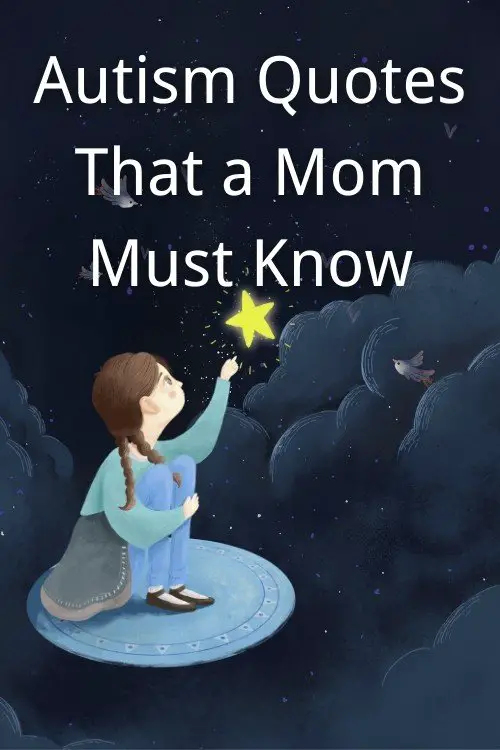
- Autism is part of my child. It’s not everything he is. My child is so much more than a diagnosis. –S.L. Coelho
- Autism doesn’t come with an instruction guide. It comes with a family who will never give up. –Kerry Magro
- I am the proud parent of the child with autism. I have more to worry about than your opinion. Don’t judge what you don’t know.
- Hope is the greatest thing for moms of autisms. Hope is what gets us out of bed in the morning. I’m on a mission to tell parents that there is a way. –Jenny McCarthy
- As a mother, I will never give up on my child. As the mother of a child who has autism, I will never give up hope. I look into his eyes, and I see all the potential he has to offer to this beautiful world and just know that one day the world will see what I see.
- Even for parents of children that are not on the spectrum, there is no such thing as a normal child. –Violet Steven, Mom
- Your child is the same person before the autism diagnosis as they are after the diagnosis. Your lifestyles and actions may change, but your love for them never will. –Alicia Trautwein
- Until you have a child with special needs, you have no idea of the depth of your strength, tenacity, and resourcefulness.
- There is nothing to be ashamed of. Every child is a blessing.
- People ask what the hardest thing is about having an autistic child, and for me, the answer is easy. What mom doesn’t want to hear her baby tell her that he loves her or to feel his arms around her? –Kristene Barnett
Autism may be a disability for others and maybe because of this, people may count my child as the odd one out, but for me, she/he is unique. My child may not be loud and rowdy but maybe he/she is a little angel in disguise who is a little more than needed involved in his/her own little world where everything fits just right, according to him.
The little angel is an individual who enjoys love and care but just doesn’t express it. He loves to paint and draw but is shy to show his creativity and skills. This child is as beautiful as every other but just a little different.
Inspirational Quotes from Temple Grandin
- What would happen if the autism gene was eliminated from the gene pool? You would have a bunch of people standing around in a cave, chatting and socializing and not getting anything done. –Temple Grandin
- There needs to be a lot more emphasis on what a child can do instead of what he cannot do. –Temple Grandin
- I am different, not less. –Temple Grandin
- The world needs different kinds of minds to work together. –Temple Grandin
- I think that autistic brains tend to be specialized brains. Autistic people tend to be less social. It takes a ton of processors space in the brain to have all the social circuits. –Temple Grandin
- It’s never too late to expand the mind of a person on the autistic spectrum. –Temple Grandin
- The most interesting people you’ll find are ones that don’t fit into your average cardboard box. They’ll make what they need; they’ll make their own boxes. –Temple Grandin
- From a scientific standpoint, Aspergers and Autism are one syndrome. Aspergers is part of the autism spectrum, not a separate disorder. –Temple Grandin
- When I was younger, I was looking for this magic meaning of life. It’s very simple now. Making the lives of others better, doing something of lasting value. That’s meaning of life; it’s that simple. –Temple Grandin
- People are always looking for a single magic bullet that will totally change everything. There is no single magic bullet. –Temple Grandin
Temple Grandin is an author and a spokesperson for humane treatment for animals. She was diagnosed as an autistic child but she never limited herself! She is also a notable advocate for autistic communities and is a professor at the Colorado University!
Being autistic doesn’t mean being any less creative or any less smart. It is only because of their challenging behavior that people are unable to recognize their incredible talent.
It is all about the support and approach you give to an autistic person. Send these inspirational quotes to anyone you know who has autism, these quotes will encourage them to do more!
Funny and Positive Sayings about Autism
- Autism is not a choice. Acceptance is. Imagine if the opposite was true. –Stuart Duncan
- Normal is a dryer setting. –Elizbeth Moon
- Some people with autism may not be able to speak or answer to their name, but they can still hear your words and feel your kindness.
- What do you think made the first stone spears? The Asperger guy. If you were to get rid of all the autism genetics, there would be no more silicon valley. –Temple Grandin
- Children with autism are angels who lost their way to heaven and fell on earth.
- Having Asperger’s means, I am a genius in my own way.
- Children with autism are colorful, they are often very beautiful, and like a rainbow, they stand out. –Adele Devine
- You see, you are only one person; therefore, capable of making a ridiculously enormous difference in the world.
- Autism is not a disability. It is a different ability. –Stuart Duncan
Your disability can never be a hindrance in your path of success. It can make you stand out and maybe above all. Above all those people, who despite being normal do not try hard enough like you, don’t strive to be the source of inspiration like you.
You can make this disability your strength and surprise all or your weakness and lead a pitiful and sympathetic life. Autistic people need a positive attitude; they should never be looked down on. Autism is just a different ability, it doesn’t stop a person from pursuing their goals, they only have a hard time communicating, which can be gradually overcome.
Autism Quotes for Teachers and Parents

- I treasure my meetings with the individuals affected by autism- parents, children, teachers, and friends. They deserve all possible opportunities for education, employment, and integration. –Ban Ki-Moon
- It shouldn’t matter how slowly some children learn as long as we are encouraging them not to stop. –Robert John Meehan
- Children with special needs should be given the best we as educators have to offer. They deserve the best practices, learning environment, material, and technology, coupled with the highest expectations for their success.
- The best thing a special education teacher brings to work are their heart and authenticity. –Amanda Friedman
- I worked for a while as a teaching assistant while I was struggling. I really enjoyed it working with kids with special needs, autism. It takes a hell of a lot of concentration. And you’ve got to focus on the child properly for seven days a week. –Joseph Mawle
- Most people don’t realize that special education teachers are really angels, disgusted as extraordinary humans.
- Parents with autistic children need the support of the entire family. Some times siblings react negatively because they find it hard to admit the problems to friends. They suffer socially and try to keep away from their autistic brothers and sisters. –Sabiha Hossain
- Sometimes all a parent needs is to know the impossible is actually possible. Hope goes a long way when it comes to autism.
- If you ask 99.9 percent of parents who have children with autism if we’d rather have the measles vs. autism, we’d sign up for measles. –Jenny McCarthy
Never make them feel inferior or not capable enough for you don’t truly know their limits. Don’t doubt their capabilities or limit their creativity. Autistic people are already battling inside so it is very important to motivate them to do better and encourage them to do something new.
It’s a challenging task to tackle an autistic individual because they can be very uncooperative at times, but in the struggle don’t snub them, just be kind and mild because they can’t change their nature.
Famous Quotes from People with Autism
- One problem with the way the educational system is set up is that it only recognizes a certain type of intelligence, and it’s incredibly restrictive- very, very restrictive. There’re so many types of intelligence, and people who would be at their best outside of that structure get lost. –Bruce Springsteen
- Autism to me is not ‘wrong,’ not subhuman, not a collection of deficits; it is simply ‘other’—another reality. And like anything different, it is going to jar. –Beth Silver
- My whole thing is to entertain, make people laugh, and forget about the real world for a while. –Dan Aykroyd
- Evil communication corrupts good manners. I hope to live to hear that good communication corrects bad manners. – Benjamin Banneker
- Visions are worth fighting for. Why spend your life making someone else’s dream? –Tim Burton
- A man who dares to waste one hour of time has not discovered the value of life. –Charles Darwin
- Within every living child exists the most precious bud of self-identity. To search this out and foster it with loving care, that is the essence of educating an autistic child. –Kiyo Kitahara
- The technology in making games and in making anime is really similar. There are common concepts. – Satoshi Tajiri
- Wanting to be free, wanting to be me, trying to make people see. And accept the real me. –Scott Lentine
If you still have doubts about autistic people not doing well, read famous quotes said by people who were autistic and super talented! These famous quotes are from people who are teachers, musicians, comedians and authors.
When autistic children and adults are encouraged, loved and supported, they shine like stars. Never undermine them, always motivate them, they are very sensitive people, but when they want to make a difference, they can turn the world upside down!
My Favorite Quotes about Autism and Aspergers
- When we cheer on each other’s loved ones to succeed as much as our own, every milestone is a celebration.
- I see people with Asperger’s syndrome as a bright thread in the rich tapestry of life. –Tony Attwood.
- Autism offers a chance for us to glimpse an awe-filled vision of the world that might otherwise pass us by. –Dr. Colin Zimbleman
- Forget about the things they can’t do and focus on what they can. Everyone is much more than a diagnosis written on paper.
- Autism is not a puzzle, not a disease. Autism is a challenge, but certainly not a devastating one. –Trisha Van Berkel
- Just because we may want to be by ourselves at times, doesn’t mean we don’t care about you.
- It seems that for success in science and art, a dash of autism is essential. –Hans Asperger
- Girls are generally recognized as superior mimics. Those with Asperger’s syndrome hold back and observe until they learn the ‘rules,’ then imitate their way through social situations. –Tony Attwood
- Showing kindness toward those who are different, and embracing our imperfections as proof of our humanness, is the remedy for fear. –Emma Zurcher-long
These people are not ordinary. They are not easy to talk to, but if you can communicate with them, they make you travel to a different world. This is a world of peace and serenity which exits in their mind. They have knowledge as wide as the ocean. They are compassionate, observant, and kind individuals on the inside.
They are much more than discovered and are yet to be known. Autistic children and adults are very unique, and when it comes to cognitive skills, they are a world apart from any other normal person.
They may not be good speakers but are excellent listeners and secret keepers. Show kindness to them, embrace each other’s imperfections, and eliminate the element of hatred.
Conclusion
Maybe you know someone who is autistic, or you are one yourself, but you know what? There is nothing to be ashamed of. Autistic people are just different, and there is no harm in being different.
So many people out there never discovered their talents because they were bullied at school simply because they were different. Autism is not a disease, it might have some loopholes, but there is nothing you can’t do if you have autism.
Everyone has an equal chance to go ahead and make their life so why doubt yourself because of others? These quotes are dedicated to every autistic person out there.
Don’t give up on yourself; you are to be treasured!











Some luxuries are obvious. A better seat on a flight. A hotel room with a view. Dinner somewhere you don’t have to look at the prices before ordering. Others are almost invisible. They’re the things you don’t have to remember anymore.
You don’t have to wonder whether there’s enough gas in the car because you filled up yesterday. You don’t have to decide what’s for dinner because it’s already planned. You don’t have to search for your keys because they finally have a permanent home.
Individually, these are tiny conveniences. Collect enough of them, though, and something interesting happens: everyday life starts requiring a little less thought.
Small Decisions Take Up More Space Than We Realize
A normal morning can contain an absurd number of choices before the workday even begins. What should you wear? Is there enough coffee? Did the kids pack everything? Does the dog need to go out? Where did you put your charger?
Researchers have long been interested in the mental processes involved in making decisions, particularly when people are faced with many choices. The American Psychological Association also notes that prolonged stress can affect concentration and decision-making, which helps explain why even minor tasks can feel disproportionately irritating when life is already busy.
The solution isn’t necessarily to optimize every minute. Sometimes it’s simply to eliminate a decision entirely.
The Best Convenience Eventually Becomes Invisible
Think about the conveniences you already rely on. Automatic bill pay doesn’t feel exciting after the first month. A password manager isn’t thrilling every time it fills in a login. Setting coffee to brew automatically stops feeling like technology and starts feeling like how mornings work.
That’s arguably when a convenience becomes most valuable: when you stop noticing it.
The same principle can apply to personal routines. Someone who has worn glasses since childhood may automatically reach toward the nightstand every morning. A contact lens wearer may pack solution, a case and backup glasses every time they travel. Those steps aren’t necessarily difficult. They’re simply always there.
For people who are appropriate candidates, laser vision correction can potentially remove some of that routine. Practices such as Travers LASIK evaluate factors such as prescription, corneal measurements and overall eye health to determine whether reducing dependence on glasses or contacts is a realistic option.
The benefit in everyday life isn’t necessarily thinking about clearer vision more. It’s potentially having to think about vision correction less.
Build Systems for the Things That Keep Coming Back
Not every recurring annoyance requires technology or a major life change. Often, the easiest way to reduce mental clutter is to notice which problems you keep solving repeatedly.
If you’re constantly searching for your keys, give them one home. If weeknight dinner becomes a daily negotiation, create a short rotation of meals everyone will eat. If you forget household supplies until they’re gone, automate the recurring order. If mornings are frantic, move a few decisions to the night before.
The goal isn’t to turn life into a productivity system. It’s to stop spending attention on problems you’ve already solved before.
Spend Attention Where It Actually Matters
There is a difference between being busy and having your attention pulled in too many directions. Ten tiny unfinished tasks can occupy more mental space than one meaningful project.
Removing a few of those tasks creates room for things that can’t be automated or prepared in advance: listening to someone, concentrating on difficult work, enjoying a trip, or simply getting through a morning without feeling behind before 8 a.m.
That’s why “one less thing to think about” can feel surprisingly luxurious. It isn’t about having fewer responsibilities or making every part of life effortless. It’s about deciding which things deserve your attention — and which ones don’t need to keep asking for it.
The best upgrades don’t always add something to your life. Sometimes, they quietly take something off your list.

In April 2026, the Medical Group Management Association released its annual burden report and drew a straight line most clinicians already felt in their bones: federal paperwork requirements, prior authorization, downcoding disputes, and MIPS reporting, are accelerating physician burnout and starting to squeeze patient access.
The finding surprised no one. What made it land was the sequencing: the paperwork keeps growing, the workforce keeps shrinking, and the years between medical school and a sustainable career are getting more administratively expensive at every stage.
So the useful question in 2026 isn’t whether admin work causes burnout. It’s where in a provider’s career the load hits, and what can be done at each stage before the clinician walks away.
Onboarding Starts With a Credentialing Marathon
Before a new provider sees a single patient, they enter a paperwork gauntlet that can last months. Credentialing in the US now takes 90 to 150 days on average, and delays are trending the wrong way. That’s a full fiscal quarter of a physician’s earning potential lost to forms, primary-source verifications, and payer queues, often while student loan payments are already due.
The frustration compounds because every payer, hospital, and facility asks for the same information in a slightly different format. Tools like credentialing management software have emerged to keep licenses, DEA registrations, board certifications, and CE records in one place, so a provider isn’t rebuilding the same packet from scratch for the fifth time in a year. It won’t shorten the payer’s review, but it does cut the self-inflicted hours.
Mid-Career Clinicians Drown in the Daily Documentation Load
Once credentialed, the paperwork doesn’t ease up. It changes shape. The EHR becomes the second full-time job. A 2025 clinician survey by Freed found that 57% of clinicians lose more than 44 hours a month to documentation alone. That’s a work week, every month, spent typing rather than practicing medicine.
The load isn’t only clinical notes. Mid-career providers deal with a rotating cast of administrative pressures that erode the workday:
- Prior authorization. Insurer approval workflows have grown more granular, and denials often require peer-to-peer calls scheduled between patients.
- Recredentialing cycles. Every two to three years, the packet gets rebuilt for each payer relationship, on top of state license and DEA renewals that never sync up.
- Quality reporting. MIPS categories, HEDIS measures, and internal dashboards all pull from overlapping data sources but rarely talk to each other.
- Inbox medicine. Patient portal messages have become a shadow clinic that runs after hours, unpaid and largely undocumented in staffing models.
Regulators Are Trying to Catch Up
The regulatory response is real, if slow. The CMS Interoperability and Prior Authorization final rule requires certain payers to build standardized APIs and shorten authorization decisions, with core provisions phasing in through 2026 and 2027. Accreditation bodies have also tightened their own credentialing windows, pushing organizations toward faster turnaround.
None of this arrives fully formed. Providers who assume the burden will lift on a specific date usually get disappointed. The smarter posture is to read the rules as tailwinds and keep tightening internal workflows in the meantime.
Late-Career Attrition Is the Bill Coming Due
The last phase of the sequence is the one nobody wants to talk about: exits. Physicians in their 50s and 60s are retiring earlier than planning models assumed, and mid-career clinicians are cutting hours, moving to concierge models, or leaving direct patient care for administrative and industry roles. Every departure compresses the schedules of the providers left behind, which feeds the next cycle of burnout.
The way out isn’t a single fix. It’s a series of small, boring wins: cleaner credentialing files, tighter documentation templates, one system of record instead of five, and honest staffing math that counts inbox and prior-auth time as real work. Paperwork fatigue got built one form at a time – it comes apart the same way.

Cosmetic surgery can change a particular feature of your appearance, but it can’t guarantee perfection. That’s an important distinction to understand before deciding whether a procedure is right for you.
Good preparation starts with knowing what a procedure can realistically achieve, what recovery involves and what risks come with it.
Whether you’re considering consulting a plastic surgeon Perth patients can see or a suitably qualified surgeon elsewhere, the consultation should be an opportunity to discuss limitations as well as potential outcomes.
Going into surgery with realistic expectations doesn’t mean expecting a poor result. It means understanding that bodies vary, healing takes time and even carefully performed procedures have limitations.
Be Specific About What You Want to Change
“I want to look better” is understandable, but it’s difficult to translate into a realistic surgical goal.
Try to identify the particular feature that concerns you and what you hope will be different afterwards.
For example, someone considering eyelid surgery might be concerned about excess skin rather than wanting their entire face to look younger. Someone considering breast surgery may have concerns about size, shape or asymmetry.
Being specific helps you have a more useful discussion with your surgeon about whether the procedure you’re considering actually addresses your concern.
Don’t Expect to Look Exactly Like Someone Else
Photographs can be useful for explaining preferences, but another person’s appearance shouldn’t be treated as a guaranteed template.
Your underlying anatomy, skin, proportions and other physical characteristics influence what can realistically be achieved.
Even photographs of previous patients need context. Before-and-after images can help you understand the type of work a surgeon performs, but another patient’s result doesn’t predict exactly how your body will respond.
A useful consultation should focus on what’s achievable for you rather than promising to reproduce someone else’s appearance.
Understand That Recovery Is Part of the Procedure
It’s easy to focus on the eventual result and underestimate what happens between surgery and getting there.
Depending on the procedure, recovery can involve swelling, bruising, discomfort, restrictions on activity and time away from work or normal routines. The area may also look quite different during early healing than it will once recovery has progressed.
Ask your surgeon practical questions such as:
- How much time might I need away from work?
- When can I drive again?
- When can I exercise?
- What assistance might I need at home?
- What symptoms are expected during recovery?
- What symptoms require urgent medical attention?
- When can the result reasonably be assessed?
Plan around the recovery you’re advised to expect, rather than assuming you’ll bounce back immediately.
Talk About Scars
Any procedure involving an incision can result in a scar.
Surgeons may plan incisions with the aim of making scars less noticeable where possible, but scars can’t simply be guaranteed to disappear. How they heal can vary between individuals.
Ask where incisions are expected to be placed, what scars may look like over time and what aftercare is recommended.
This conversation is particularly important if the visibility of a scar would significantly affect how you feel about the result.
Understand the Risks, Not Just the Benefits
Cosmetic surgery is still surgery.
Potential complications vary according to the procedure and individual patient, so the risks should be discussed specifically with your surgeon. These may include problems related to infection, bleeding, anaesthesia, wound healing, scarring, sensation or the final cosmetic result.
You should also understand whether further surgery could ever be required.
A consultation that focuses entirely on benefits without giving you a clear opportunity to understand risks and alternatives should make you cautious.
Remember That Symmetry Has Limits
Human bodies aren’t perfectly symmetrical.
One eyebrow may sit slightly higher than the other. Breasts can naturally differ in size or position. The two sides of the face aren’t exact mirror images.
Surgery may improve particular asymmetries in some circumstances, but expecting mathematically perfect symmetry is usually unrealistic.
Ask what differences are likely to remain after the procedure. Knowing this beforehand can prevent normal variations from becoming disappointing surprises afterwards.
Think About Why You Want the Procedure
This is one of the most useful questions you can ask yourself.
Cosmetic surgery is a personal decision. Ideally, the motivation comes from something you’ve considered carefully rather than pressure from a partner, comments from other people or the belief that changing your appearance will automatically transform unrelated areas of your life.
Give yourself permission to wait if you’re uncertain.
You can attend a consultation, gather information and decide not to proceed. Surgery doesn’t need to be the automatic next step simply because you’ve spoken with a surgeon.
Ask What Happens If the Result Isn’t What You Expected
Before surgery, understand how follow-up care works.
Ask when postoperative appointments occur, who you contact if you’re concerned during recovery and how unexpected outcomes or complications are handled.
It’s also worth understanding the surgeon’s policy regarding revision procedures, including circumstances where additional costs could apply.
These conversations can feel awkward, but they’re much easier to have before making a decision.
Cosmetic surgery should be approached with the same care you would give any significant medical procedure. Take time to understand the likely outcome, limitations, risks, recovery and alternatives, and make sure you have an opportunity to ask questions without feeling rushed.
The goal isn’t to expect perfection. It’s to know what you’re agreeing to and make a decision based on realistic information about what surgery may — and may not — be able to change.

Why “One Less Thing to Think About” Is an Underrated Luxury

Why Football Fans Never Forget an Underdog Win

The Hidden Admin Load Reshaping Healthcare Burnout in 2026

The Cost of Deferred Maintenance: How Small Building Problems Become Big Business Expenses

The Cleaning Decisions That Shape Focus, Mood, and Sick Days at Work

The Sticky House Problem: Why Your AC Cools the Air but Leaves the Room Feeling Damp

Why “Good Enough” Is a Skill: How Precision Thinking Improves Everyday Decisions

Substack on Windows: following writers, podcasts, and livestreams

When AI Answers the Sponsorship Question Before Fans Ever Click

From Prediction to Kick-Off: What Sports Fans Check Before a Big Match

What Happens After You’re Arrested For Driving While Intoxicated?

10 Reasons LEGO is Worth Getting into as an Adult

Actionable SWOT: How to Turn Your Strategic Analysis into a Functional Work Plan

Four Ways to Reduce Risk in Your Technology Supply Chain

What to Do When Everyday Movements Become Painful

So You’ve Got Multiple Offers for Your Business. Now What?

What Is the Construction Process Behind Modern Wind Power Plants?

How to Recover Faster From Everyday Injuries

How to Identify and Eliminate Efficiency Gaps in Complex Business Operations

Top Ways to Ask for Help

 Business12 months ago
Do You Really Need Those Extra Features? Here’s How to Decide for Your Business

 Health12 months ago
The Power of Prevention in Modern Medicine

 Entertainment10 months ago
Casino Bonuses in Latvia: Comparing Offers and Tips for Beginners

 Tech12 months ago
Your Guide to Protecting Your Digital Peace of Mind

 LifeStyle10 months ago
Why Support Systems Matter More Than We Admit During Hard Times

 LifeStyle8 months ago
Should You Buy or Build Your Next Home? Here’s How to Decide (Without Losing Sleep Over It)

 Work11 months ago
How to Create a Comfortable Environment for Your Team

 Health10 months ago
The Support Systems That Keep Independent Practices Competitive