
Health
65 ADHD Quotes to Help You Understand It Better


Attention-deficit hyperactivity disorder (ADHD) is a common and known mental illness in children. It affects a good number of adults also.
Attention deficit hyperactivity disorder (ADHD) is a medical condition. It is a neurological disease. The elements of the brain are affected by ADHD. It affects our ability to pay attention, sit still, and behavior management capacity.
ADHD is not a disease that can be prevented or cured. It usually affects a child in class, at home, and in friendships. It happens in children and adolescents and would possibly continue into adulthood. It is mostly seen in the initial school years when a kid begins to pay attention to something.
People seldom identify ADHD as a condition of disability, like other visible disabilities, because ADHD is an invisible medical condition. It demands understanding and acceptance. Individuals with ADHD need some accommodation now and then to satisfy their potential.
Table of Contents
ADHD Quotes to Open Our Mind
- Picture a room with 1,000 TVs with each TV showing something different. Now try and concentrate on just one TV without getting distracted. –Damian DaViking Aird
- Every person with ADHD already knows that destination addiction is part of their disorder. However, if it doesn’t have a positive outlet, it can destroy your life. It is not another person that will make your life better; it is the qualities in them that you admire. Incorporate those attributes into your own life and you won’t miss a thing. –Shannon L. Alder
- ADHD is real and valid. The sooner we recognize the patterns and learn to work with these kids, the better assured we will be that they as adults with being healthy members of society. –Rhonda Van Diest
- ADHD is not about knowing what to do, but about doing what one knows. –Dr. Russell Barkley
- In the power of fixing the attention lies the most precious of the intellectual habits. –Robert Hall
- Nothing like ADHD and a good fight to the death to make time fly. –Rick Riordan
- It’s more than lack of focus. –Jennifer Lynn
- There is no more miserable human being than one in whom nothing is habitual but indecision. –William James
Children and adults with ADHD are not a burden on us. We should not treat them as absent-minded people. Their suffering from ADHD is real and valid. The earlier we understand the patterns and learn to work with ADHD patients, the better they will become healthy social order members.
To a child, parents and teachers are the most influential person. Their lack of understanding and knowledge about ADHD is disturbing for a child. They should realize that ADHD is not a behavior issue. Instead, it is a mental health issue.
Parents may recognize their kids’ learning difficulties early and create an environment that helps them gain self-confidence, self-esteem, and independence.
In most cases, it is evident that teachers face difficulties communicating within their classrooms. We all need to provide an atmosphere in the school that focuses on promoting all students’ success.
We have to admit that ADHD is something life-destroying. We can easily manage it if we only take good care and meditation. Above are some life turning quotes on ADHD that can change our attitudes towards the ADHD patient.
Funny ADHD Quotes to Make You Laugh
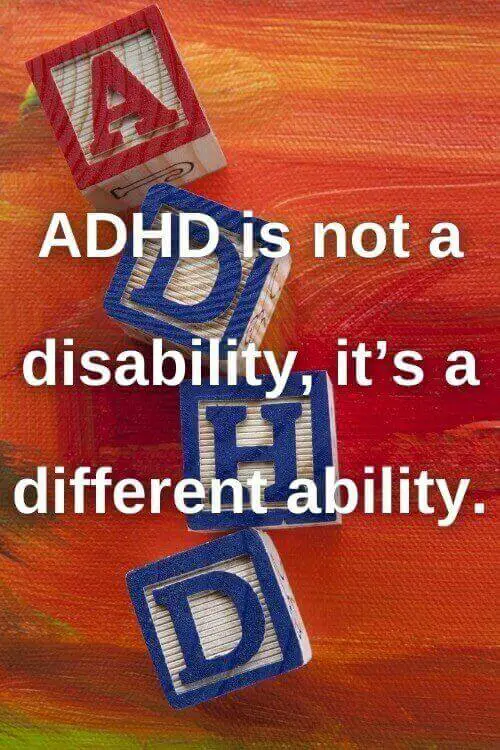
- ADHD is not a disability, it’s a different ability.
- I may have ADHD but ADHD doesn’t have me.
- You say potatoe I say potato. You say pinterest I say ADHD crack. Lets call the whole thing meatloaf. Hi.
- ADHD is just another word for fun, exciting, and adventurous.
- Ask me about my attention deficit disorder or pie or my cat. A dog. I have a bike. Do you like tv? I saw a rock. Hi
- I keep getting distracted while trying to read a book about how not to get distracted.
- I tried being normal once. Most boring two minutes of my life!
- My ADHD makes it hard for me to focus and focus sound like hocus pocus and I really like magic a whole whole lot.
- Nothing says work efficiency like panic mode. –Don Roff
- I don’t have a short attention span, I just… Oh! Look a chicken!
- Forgetting to do the thing that helps me not forget to do things is the thing that I forgot to do.
- You can teach a turkey to climb a tree, but I’d rather hire a squirrel.
There are a lot of people with ADHD who have unique gifts to offer. People with ADHD work twice as hard as anyone else to maintain a sense of normality.
They are different, and being different is not a bad thing. Sometimes it can prove incredibly good indeed! They may feel low when others remind them about their poor performances. But a new way to look at it can change everything in life.
Just love your flaws and laugh along with the chaotic moments instead of beating yourself up over them.
Funny quotes about living with ADHD will help you crack a smile after a stressful, disappointing day.
ADHD Quotes for My Son to Keep in Mind
- Do not say, that child has ADHD. Say it: He wears the 7R gene. –Gert Van Mol
- ADHD is just another word for fun, exciting and adventurous. –Julie Posey
- If we run every class the way we run it for kids with ADHD, we’d probably have a much stronger education system. –Robert Reid
- ADHD is not a choice or bad parenting. Kids with ADHD work twice as hard as their peers everyday but receive more negative feedback from the world. –DRB
- Having a high IQ or being intelligent does not mean ADHD is not a disability. –Y.T.
- Even close family members don’t understand. They think that my daughter is just spoiled. They don’t spend countless hours reading and researching and trying different things to find what works and what doesn’t. –C.A.
- I wish people simply knew that ADHD is so much more than just “being hyper.” –S.S.
- I am not absentminded. It is the presence of mind that makes me unaware of everything else. –G.K. Chesterton
Boys are more vulnerable to have ADHD than girls. Parents of a son with ADHD have to go through with child misbehaves, destructive attitudes, and criticize other people.
The painful truth about ADHD is that outsiders can not see it. So when they see the child’s misbehaviors, they may assume that the child is a brat and the parents are not good enough. Friends and family may criticize the parent’s choices.
ADHD affects the person and the entire family, including parents and the extended family of parental siblings and grandparents. An only a supportive, understanding and loving family can quickly overcome the crises they face due to a son with ADHD.
Such situations may, most of the time, affects the mental peace of your son.
Ask your son to overhear the criticism and advise him to remember the above quotes about ADHD.
ADHD Awareness Quotes to Help Take This Positively
- That’s the other thing: Even if you’re on medication, you still have to treat your body properly and take care of yourself. The idea that ADHD goes away or you grow out of it isn’t true. –Ty Pennington
- ADHD is a neurological and behavioral disorder that affects not only the person with it, but the entire family, including parents and the extended family of parental siblings and grandparents. It tests the limits of the family’s ability to be supportive, understanding and loving. –Dresher Larry
- When you have ADHD your home reflects our thought. Disorganized and in disarray. And like with a disorganized house. you can only apologize for your disorganized brain so many time before it becomes exhausting. –Sarah Young
- When I first took ADHD medications it was just like the first time I got glasses…the world came into focus. I just wish I could have had them forty years ago. My life would be very different.
- For me, anyway, having ADHD is like walking one step in front of a rain cloud, two steps in front of a thunderstorm [and], three steps in front of a tornado. Forgetting things, making careless errors, being confused. … these things can create havoc! The important thing I’ve learned is to accept errors as quickly as I can, remedy the situation, issue an apology as needed…. and keep moving forward. After all, the sky is clear and the sun is shining up ahead! –LJP
- It’s like being a cat with 100 people with laser pointers. –Jamie Hynds
- ADHD is real and valid. The sooner we recognize the patterns and learn to work with these kids, the better assured we will being that they as adults with be healthy members of society. –Rhonda Van Diest
People may be willing to help you if they can see your physical disability. But in the case of ADHD, which is not visible, people neither consider it nor acknowledge the hardship you and your family are going through. Their comments on the behavior only increase the depression of the kids who have ADHD.
These different kids need someone in their corner to support them. They can continuously come up with new ideas and new things. Kids may have many gifts from their ADHD, including unending creativity, thinking outside the box, energy, enthusiasm, and passion for their interests.
To turn a kid into a specially blessed kid, we all need nothing but to take this ADHD positively. These awareness quotes on ADHD will make you think differently about ADHD.
Short ADHD Quotes for Adults to Save for a Bad Day

- Remember that you are not alone. There are others going through the same things. –Adam Levine
- If someone told me I could be normal or continue to have ADD, I would take the ADD. –David Neeleman
- The diagnosis made me want to prove everyone wrong. I knew that, if I collaborated with Micheal, he could achieve anything he set his mind to. –Debbie Phelps
- Normal is overrated. –Lisa Aro
- I didn’t let ADHD prevent me from achieving my goals, and neither should you. –Howie Mandel
- I can only assume what normal is. –Jeffrey Siegel
- Movies kind of saved me from shame –Steven Spielberg
- Don’t be afraid to ask for help, and to admit when you need it. –Charles Schwab
- The very traits that once held Ty back are now his greatest assets –Yvonne pennington
- You can’t change who you are, and you shouldn’t be asked to. –Jonathan Mooney
An adult may be diagnosed with ADHD at any stage of his life. But well-aware of the symptoms throughout his life can save him from being alone throughout life.
While you have ADHD for the rest of your life, it will not hold you back if you make your path to get where you want to go.
Adults also can seek help for ADHD. It’s never too late. ADHD or learning disabilities would not prevent you from becoming a success.
Many adults with ADHD have proved themselves bright, creative, and funny. So don’t dim your energy by trying to fit your outsized personality into society’s little box.
David Neelma, JetBlue Airways founder, invented the e-Ticket and established the airline fighting with ADHD. According to him. Disorganization, postponement, inability to focus, and all the other harmful things of ADHD cannot stop you from being creative and able to take risks.
The iconic Hollywood director Steven Spielberg did not let a learning disability hold him back. He claims his movies saved him from shame.
Be inspired by these ADHD quotes, who never stopped believing they could achieve greatness.
Understanding ADHD Quotes All of Us Need to Read
- There is no more miserable human being than one in whom nothing is habitual but indecision. –William James
- ADHD isn’t a bad thing, and you shouldn’t feel different from those without ADHD. –Adam Levine
- It’s like opening 100 tabs in your browser at once and trying to do something different in each one at the same time. Then someone walks up and wants to have a conversation. –Jennifer Arnott
- This is a mental health issue, not a behavior issue! People including doctors and schools need to recognize it as such! –Ridge Meadows
- Because ADHD is not a visible medical disorder people don’t understand that it is just as disabling as those that are very visible. It requires understanding and acceptance that people with ADHD need some accommodations at times to perform to their potential.
- Be patient with me. Understand why I do the things I do. Don’t yell at me. Believe me, I don’t want to have ADHD. –Joane E Richardson
- It’s like trying to listen to your favorite show with really bad noise disrupting the signal. All the while, loud children are screaming around you and throwing things. –Christine Ashley
Understanding others means to recognize their point of view and accept that it is different from yours. When we know other people’s feelings, it can guide our interactions with them.
We may know someone who lives with ADHD around us. No matter how well we know him, it is not easy to understand the condition and how it affects his behavior. Thinking ADHD as bad is nothing but the frame of mind. It can be changed with little inspiration and a different perspective.
The main obstacle to our understanding of a person with ADHD is the incorrect assumption that they can behave like the rest of us. But in reality, no matter how hard they try, they can not make it possible. The only outcome would be a failure. They are different, we must admit.
ADHD can not be called a disorder, because it may come with so many positive features. People with an ADHD-style nervous system can be great problem-solvers. They are courteous, likable people with a sense of humor.
Attention Deficit Disorder Quotes for Child to Raise Our Attention
- ADD is like going through life, carrying a one-man band contraption with a broken strap. –Julia Smith-Ruetz
- It is difficult to instruct children because of their natural inattention; the true mode, of course, is to first make our modes interesting to them. –John Locke
- I prefer to distinguish ADD as attention abundance disorder. Everything is just so interesting, remarkably at the same time. –Frank Coppola
- ADHD can affect every area of your life. –Natasha McCulloch
- Having a child with ADHD is like having three children. It’s exhausting! –HK
- If we run every class the way we run it for kids with ADHD, we’d probably have a much stronger education system. –Robert Reid
- I am proud of someone with ADHD and I am proud to support ADHD awareness and acceptance.
- Everybody is genius but if you judge a fish by its ability to climb a tree, it will live its whole life believing that it is stupid.
Children with ADHD live in a permanent present and have a hard time learning from the past or looking to the future to see their inevitable consequences.
Consider the qualities that would assure a person’s success in life. You may mention being bright, creative, intelligent, and well-liked, hardworking, diligent, etc. Research has proved that children with ADHD can possess all these traits.
Even a child with ADHD can produce lots of high-quality work in a short time.
We hope these inspiring ADHD quotes for Child will help us give proper attention and remind us what is essential.
Living with ADHD Quotes That’ll Make You More Peaceful
- I am not absentminded. It is the presence of mind that makes me unaware of everything else. –G.K. Chesterton
- People with ADHD often have a special feel for life, a way of seeing right into the heart of matters, while others have to reason their way methodically. –Edward M. Hallowell
- Forgive your child and yourself nightly. You didn’t ask to live with the effects of ADHD any more than did your child. –Martin L. Kutscher
- Living with ADHD is like walking up a down escalator. You can get there eventually but the journey is exhausting. –Kathleen Ely
- Living with ADHD is like being locked in a room with 100 Televisions and 100 Radios all playing. None of them have power buttons so you can turn them off and the door is locked from the outside. –Sarah Young
When someone is diagnosed with ADHD, it may feel like the universe has conspired against him. No effort or positive thinking will make a difference. Such negative thinking tends to lower self-esteem, which leads to bad choices and even worse reactions.
ADHD can make you blunder and feel short on hope sometimes. The key is to cope with setbacks with grace and pick yourself up. Each time you struggle, it builds your strength and resiliency to carry on.
When things are going wrong, you may remember this will pass, and at the finish line, it will all be worthwhile.
Conclusion
ADHD, the brain disorder, is usually spotted during the early school years when a child begins to have problems paying attention. Identifying it early, plus having a fair treatment and education plan, can help a child or adult manage their symptoms.
We must remember that the population with ADHD have unique gifts to offer. They have stories to tell. They can help others. They can work hard and love the people around them.
Without acknowledgment and acceptance of their ADHD by themselves and others, they may bury their gifts. Suppose they are always working on measuring up and are severely misunderstood by their loved ones.
In that case, they may die with their stories. They may fail to learn to express the love they truly feel for the people. Hug them. Help a friend with ADHD.












Some luxuries are obvious. A better seat on a flight. A hotel room with a view. Dinner somewhere you don’t have to look at the prices before ordering. Others are almost invisible. They’re the things you don’t have to remember anymore.
You don’t have to wonder whether there’s enough gas in the car because you filled up yesterday. You don’t have to decide what’s for dinner because it’s already planned. You don’t have to search for your keys because they finally have a permanent home.
Individually, these are tiny conveniences. Collect enough of them, though, and something interesting happens: everyday life starts requiring a little less thought.
Small Decisions Take Up More Space Than We Realize
A normal morning can contain an absurd number of choices before the workday even begins. What should you wear? Is there enough coffee? Did the kids pack everything? Does the dog need to go out? Where did you put your charger?
Researchers have long been interested in the mental processes involved in making decisions, particularly when people are faced with many choices. The American Psychological Association also notes that prolonged stress can affect concentration and decision-making, which helps explain why even minor tasks can feel disproportionately irritating when life is already busy.
The solution isn’t necessarily to optimize every minute. Sometimes it’s simply to eliminate a decision entirely.
The Best Convenience Eventually Becomes Invisible
Think about the conveniences you already rely on. Automatic bill pay doesn’t feel exciting after the first month. A password manager isn’t thrilling every time it fills in a login. Setting coffee to brew automatically stops feeling like technology and starts feeling like how mornings work.
That’s arguably when a convenience becomes most valuable: when you stop noticing it.
The same principle can apply to personal routines. Someone who has worn glasses since childhood may automatically reach toward the nightstand every morning. A contact lens wearer may pack solution, a case and backup glasses every time they travel. Those steps aren’t necessarily difficult. They’re simply always there.
For people who are appropriate candidates, laser vision correction can potentially remove some of that routine. Practices such as Travers LASIK evaluate factors such as prescription, corneal measurements and overall eye health to determine whether reducing dependence on glasses or contacts is a realistic option.
The benefit in everyday life isn’t necessarily thinking about clearer vision more. It’s potentially having to think about vision correction less.
Build Systems for the Things That Keep Coming Back
Not every recurring annoyance requires technology or a major life change. Often, the easiest way to reduce mental clutter is to notice which problems you keep solving repeatedly.
If you’re constantly searching for your keys, give them one home. If weeknight dinner becomes a daily negotiation, create a short rotation of meals everyone will eat. If you forget household supplies until they’re gone, automate the recurring order. If mornings are frantic, move a few decisions to the night before.
The goal isn’t to turn life into a productivity system. It’s to stop spending attention on problems you’ve already solved before.
Spend Attention Where It Actually Matters
There is a difference between being busy and having your attention pulled in too many directions. Ten tiny unfinished tasks can occupy more mental space than one meaningful project.
Removing a few of those tasks creates room for things that can’t be automated or prepared in advance: listening to someone, concentrating on difficult work, enjoying a trip, or simply getting through a morning without feeling behind before 8 a.m.
That’s why “one less thing to think about” can feel surprisingly luxurious. It isn’t about having fewer responsibilities or making every part of life effortless. It’s about deciding which things deserve your attention — and which ones don’t need to keep asking for it.
The best upgrades don’t always add something to your life. Sometimes, they quietly take something off your list.

In April 2026, the Medical Group Management Association released its annual burden report and drew a straight line most clinicians already felt in their bones: federal paperwork requirements, prior authorization, downcoding disputes, and MIPS reporting, are accelerating physician burnout and starting to squeeze patient access.
The finding surprised no one. What made it land was the sequencing: the paperwork keeps growing, the workforce keeps shrinking, and the years between medical school and a sustainable career are getting more administratively expensive at every stage.
So the useful question in 2026 isn’t whether admin work causes burnout. It’s where in a provider’s career the load hits, and what can be done at each stage before the clinician walks away.
Onboarding Starts With a Credentialing Marathon
Before a new provider sees a single patient, they enter a paperwork gauntlet that can last months. Credentialing in the US now takes 90 to 150 days on average, and delays are trending the wrong way. That’s a full fiscal quarter of a physician’s earning potential lost to forms, primary-source verifications, and payer queues, often while student loan payments are already due.
The frustration compounds because every payer, hospital, and facility asks for the same information in a slightly different format. Tools like credentialing management software have emerged to keep licenses, DEA registrations, board certifications, and CE records in one place, so a provider isn’t rebuilding the same packet from scratch for the fifth time in a year. It won’t shorten the payer’s review, but it does cut the self-inflicted hours.
Mid-Career Clinicians Drown in the Daily Documentation Load
Once credentialed, the paperwork doesn’t ease up. It changes shape. The EHR becomes the second full-time job. A 2025 clinician survey by Freed found that 57% of clinicians lose more than 44 hours a month to documentation alone. That’s a work week, every month, spent typing rather than practicing medicine.
The load isn’t only clinical notes. Mid-career providers deal with a rotating cast of administrative pressures that erode the workday:
- Prior authorization. Insurer approval workflows have grown more granular, and denials often require peer-to-peer calls scheduled between patients.
- Recredentialing cycles. Every two to three years, the packet gets rebuilt for each payer relationship, on top of state license and DEA renewals that never sync up.
- Quality reporting. MIPS categories, HEDIS measures, and internal dashboards all pull from overlapping data sources but rarely talk to each other.
- Inbox medicine. Patient portal messages have become a shadow clinic that runs after hours, unpaid and largely undocumented in staffing models.
Regulators Are Trying to Catch Up
The regulatory response is real, if slow. The CMS Interoperability and Prior Authorization final rule requires certain payers to build standardized APIs and shorten authorization decisions, with core provisions phasing in through 2026 and 2027. Accreditation bodies have also tightened their own credentialing windows, pushing organizations toward faster turnaround.
None of this arrives fully formed. Providers who assume the burden will lift on a specific date usually get disappointed. The smarter posture is to read the rules as tailwinds and keep tightening internal workflows in the meantime.
Late-Career Attrition Is the Bill Coming Due
The last phase of the sequence is the one nobody wants to talk about: exits. Physicians in their 50s and 60s are retiring earlier than planning models assumed, and mid-career clinicians are cutting hours, moving to concierge models, or leaving direct patient care for administrative and industry roles. Every departure compresses the schedules of the providers left behind, which feeds the next cycle of burnout.
The way out isn’t a single fix. It’s a series of small, boring wins: cleaner credentialing files, tighter documentation templates, one system of record instead of five, and honest staffing math that counts inbox and prior-auth time as real work. Paperwork fatigue got built one form at a time – it comes apart the same way.

Cosmetic surgery can change a particular feature of your appearance, but it can’t guarantee perfection. That’s an important distinction to understand before deciding whether a procedure is right for you.
Good preparation starts with knowing what a procedure can realistically achieve, what recovery involves and what risks come with it.
Whether you’re considering consulting a plastic surgeon Perth patients can see or a suitably qualified surgeon elsewhere, the consultation should be an opportunity to discuss limitations as well as potential outcomes.
Going into surgery with realistic expectations doesn’t mean expecting a poor result. It means understanding that bodies vary, healing takes time and even carefully performed procedures have limitations.
Be Specific About What You Want to Change
“I want to look better” is understandable, but it’s difficult to translate into a realistic surgical goal.
Try to identify the particular feature that concerns you and what you hope will be different afterwards.
For example, someone considering eyelid surgery might be concerned about excess skin rather than wanting their entire face to look younger. Someone considering breast surgery may have concerns about size, shape or asymmetry.
Being specific helps you have a more useful discussion with your surgeon about whether the procedure you’re considering actually addresses your concern.
Don’t Expect to Look Exactly Like Someone Else
Photographs can be useful for explaining preferences, but another person’s appearance shouldn’t be treated as a guaranteed template.
Your underlying anatomy, skin, proportions and other physical characteristics influence what can realistically be achieved.
Even photographs of previous patients need context. Before-and-after images can help you understand the type of work a surgeon performs, but another patient’s result doesn’t predict exactly how your body will respond.
A useful consultation should focus on what’s achievable for you rather than promising to reproduce someone else’s appearance.
Understand That Recovery Is Part of the Procedure
It’s easy to focus on the eventual result and underestimate what happens between surgery and getting there.
Depending on the procedure, recovery can involve swelling, bruising, discomfort, restrictions on activity and time away from work or normal routines. The area may also look quite different during early healing than it will once recovery has progressed.
Ask your surgeon practical questions such as:
- How much time might I need away from work?
- When can I drive again?
- When can I exercise?
- What assistance might I need at home?
- What symptoms are expected during recovery?
- What symptoms require urgent medical attention?
- When can the result reasonably be assessed?
Plan around the recovery you’re advised to expect, rather than assuming you’ll bounce back immediately.
Talk About Scars
Any procedure involving an incision can result in a scar.
Surgeons may plan incisions with the aim of making scars less noticeable where possible, but scars can’t simply be guaranteed to disappear. How they heal can vary between individuals.
Ask where incisions are expected to be placed, what scars may look like over time and what aftercare is recommended.
This conversation is particularly important if the visibility of a scar would significantly affect how you feel about the result.
Understand the Risks, Not Just the Benefits
Cosmetic surgery is still surgery.
Potential complications vary according to the procedure and individual patient, so the risks should be discussed specifically with your surgeon. These may include problems related to infection, bleeding, anaesthesia, wound healing, scarring, sensation or the final cosmetic result.
You should also understand whether further surgery could ever be required.
A consultation that focuses entirely on benefits without giving you a clear opportunity to understand risks and alternatives should make you cautious.
Remember That Symmetry Has Limits
Human bodies aren’t perfectly symmetrical.
One eyebrow may sit slightly higher than the other. Breasts can naturally differ in size or position. The two sides of the face aren’t exact mirror images.
Surgery may improve particular asymmetries in some circumstances, but expecting mathematically perfect symmetry is usually unrealistic.
Ask what differences are likely to remain after the procedure. Knowing this beforehand can prevent normal variations from becoming disappointing surprises afterwards.
Think About Why You Want the Procedure
This is one of the most useful questions you can ask yourself.
Cosmetic surgery is a personal decision. Ideally, the motivation comes from something you’ve considered carefully rather than pressure from a partner, comments from other people or the belief that changing your appearance will automatically transform unrelated areas of your life.
Give yourself permission to wait if you’re uncertain.
You can attend a consultation, gather information and decide not to proceed. Surgery doesn’t need to be the automatic next step simply because you’ve spoken with a surgeon.
Ask What Happens If the Result Isn’t What You Expected
Before surgery, understand how follow-up care works.
Ask when postoperative appointments occur, who you contact if you’re concerned during recovery and how unexpected outcomes or complications are handled.
It’s also worth understanding the surgeon’s policy regarding revision procedures, including circumstances where additional costs could apply.
These conversations can feel awkward, but they’re much easier to have before making a decision.
Cosmetic surgery should be approached with the same care you would give any significant medical procedure. Take time to understand the likely outcome, limitations, risks, recovery and alternatives, and make sure you have an opportunity to ask questions without feeling rushed.
The goal isn’t to expect perfection. It’s to know what you’re agreeing to and make a decision based on realistic information about what surgery may — and may not — be able to change.

Why “One Less Thing to Think About” Is an Underrated Luxury

Why Football Fans Never Forget an Underdog Win

The Hidden Admin Load Reshaping Healthcare Burnout in 2026

The Cost of Deferred Maintenance: How Small Building Problems Become Big Business Expenses

The Cleaning Decisions That Shape Focus, Mood, and Sick Days at Work

The Sticky House Problem: Why Your AC Cools the Air but Leaves the Room Feeling Damp

Why “Good Enough” Is a Skill: How Precision Thinking Improves Everyday Decisions

Substack on Windows: following writers, podcasts, and livestreams

When AI Answers the Sponsorship Question Before Fans Ever Click

From Prediction to Kick-Off: What Sports Fans Check Before a Big Match

What Happens After You’re Arrested For Driving While Intoxicated?

10 Reasons LEGO is Worth Getting into as an Adult

Actionable SWOT: How to Turn Your Strategic Analysis into a Functional Work Plan

Four Ways to Reduce Risk in Your Technology Supply Chain

What to Do When Everyday Movements Become Painful

So You’ve Got Multiple Offers for Your Business. Now What?

What Is the Construction Process Behind Modern Wind Power Plants?

How to Recover Faster From Everyday Injuries

How to Identify and Eliminate Efficiency Gaps in Complex Business Operations

Top Ways to Ask for Help

 Business12 months ago
Do You Really Need Those Extra Features? Here’s How to Decide for Your Business

 Health12 months ago
The Power of Prevention in Modern Medicine

 Entertainment10 months ago
Casino Bonuses in Latvia: Comparing Offers and Tips for Beginners

 Tech12 months ago
Your Guide to Protecting Your Digital Peace of Mind

 LifeStyle10 months ago
Why Support Systems Matter More Than We Admit During Hard Times

 LifeStyle8 months ago
Should You Buy or Build Your Next Home? Here’s How to Decide (Without Losing Sleep Over It)

 Work11 months ago
How to Create a Comfortable Environment for Your Team

 Health10 months ago
The Support Systems That Keep Independent Practices Competitive